Why Sump Pumps Fail During Nor'easters (And How to Keep Your Basement Dry)
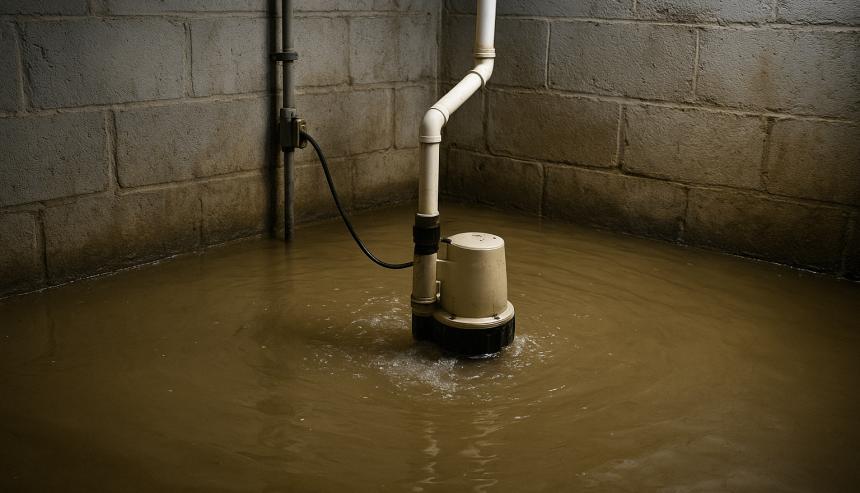
Here's the cruel part of a flooded basement: the sump pump usually works fine 364 days a year. It fails on the one day a nor'easter dumps rain and snowmelt and knocks the power out at the same time. Here's why that timing isn't bad luck — it's built in. The catch: the fix is a backup that runs when the grid doesn't.
People assume a working sump pump means a dry basement. It doesn't. A sump pump is only as reliable as the power feeding it, and in Massachusetts the heaviest water and the worst outages arrive in the same storm.
The stakes are steep. Just one inch of basement water can cause $25,000+ in damage, and standard homeowner's insurance generally does not cover groundwater flooding without a separate rider. A finished basement turns that into a gut-and-rebuild. The pump is a $200 part guarding a five-figure room.
Here is the reframe: a sump pump doesn't fail from the water — it fails from the power. The pit fills exactly when the nor'easter takes out the lines, so the single pump on a single outlet is dead at the worst possible moment. The whole game is keeping a pump running after the lights go off.
By the end of this you'll be able to:
→ Understand why storms and outages hit at the same time
→ Know the four ways a sump pump fails
→ Pick the right backup for your basement
→ Test the system before the wet season, not during it
The power failures
Start here because… this is how most nor'easter floods actually happen.
Outage during peak inflow. The storm fills the pit and cuts the power in the same hour. A pump with no backup simply stops — and the water keeps rising.
Tripped breaker or unplugged outlet. A surge trips the GFCI, or the plug got bumped months ago. The pump looks fine and does nothing when called.
The mechanical failures
What you're dealing with is usually… a pump that's worn out or overwhelmed.
Stuck or stranded float switch. Debris jams the float, or it wedges against the pit wall, so the pump never switches on. The most common mechanical failure there is.
Undersized or aging pump. Sump pumps last about 7–10 years, and a single small unit can't keep up with nor'easter-level inflow. It runs nonstop, overheats, and quits.
The discharge failures
Reality is: a pump that runs is useless if the water can't get out.
Frozen or clogged discharge line. An iced-over or blocked outlet pipe sends water straight back into the pit. Common in MA when storms swing around the freezing mark.
Build a basement that stays dry
1. Battery backup pump: the core upgrade — kicks in automatically when the power drops, runs for hours on a charged battery.
2. Water-powered backup: runs off municipal water pressure with no battery to die — ideal for long outages (city-water homes only).
3. Dual-pump pit: a second primary pump that shares the load and covers the first one's failure.
4. Check valve + clear discharge: stops backflow and keeps the outlet from freezing or clogging.
5. Water alarm or smart monitor: texts you the moment the pit rises — warning before the water does.
Where this goes wrong
You trust one pump on one outlet. In a high-water-table MA basement, that's one outage from a flood. Redundancy isn't optional here.
You never test it. Pour a bucket in the pit twice a year. A pump that hasn't run in months is a pump you're guessing about.
You skip the backup battery's age. Backup batteries fade in 3–5 years. A dead battery is the same as no backup — just more expensive.
The build order
→ First, test the existing pump and clear the float and discharge — free, and it catches the obvious failures.
→ Second, add a battery (or water-powered) backup — the single biggest protection against a nor'easter outage.
→ Third, add a check valve and a water alarm so backflow and rising water can't surprise you.
→ Last, consider a dual-pump pit if you have a finished basement or a history of flooding.
The bottom line
Sump pumps don't fail because the water won — they fail because the power left. Add a backup that runs without the grid, test it before the wet season, and a nor'easter stays outside where it belongs.
The storm brings the water and takes the power in one move. Beat it with a pump that doesn't need the grid.
Tools you'll need for this job
If you want to do it yourself, here are the tools you'll need:
As an Amazon Associate, SouthCoast Plumbers earns from qualifying purchases.
Tools & parts for this fix
Storm-season insurance for your basement:
As an Amazon Associate, SouthCoast Plumbers earns from qualifying purchases. Prices and availability are set by Amazon.
Wet basement when it storms?
Browse trusted local SouthCoast plumbers who install battery and water-powered backups — and test the whole system before nor'easter season.
Find a plumber