
Outdoor Faucet Freezing: The Fall Mistake That Bursts Pipes Inside Your Walls
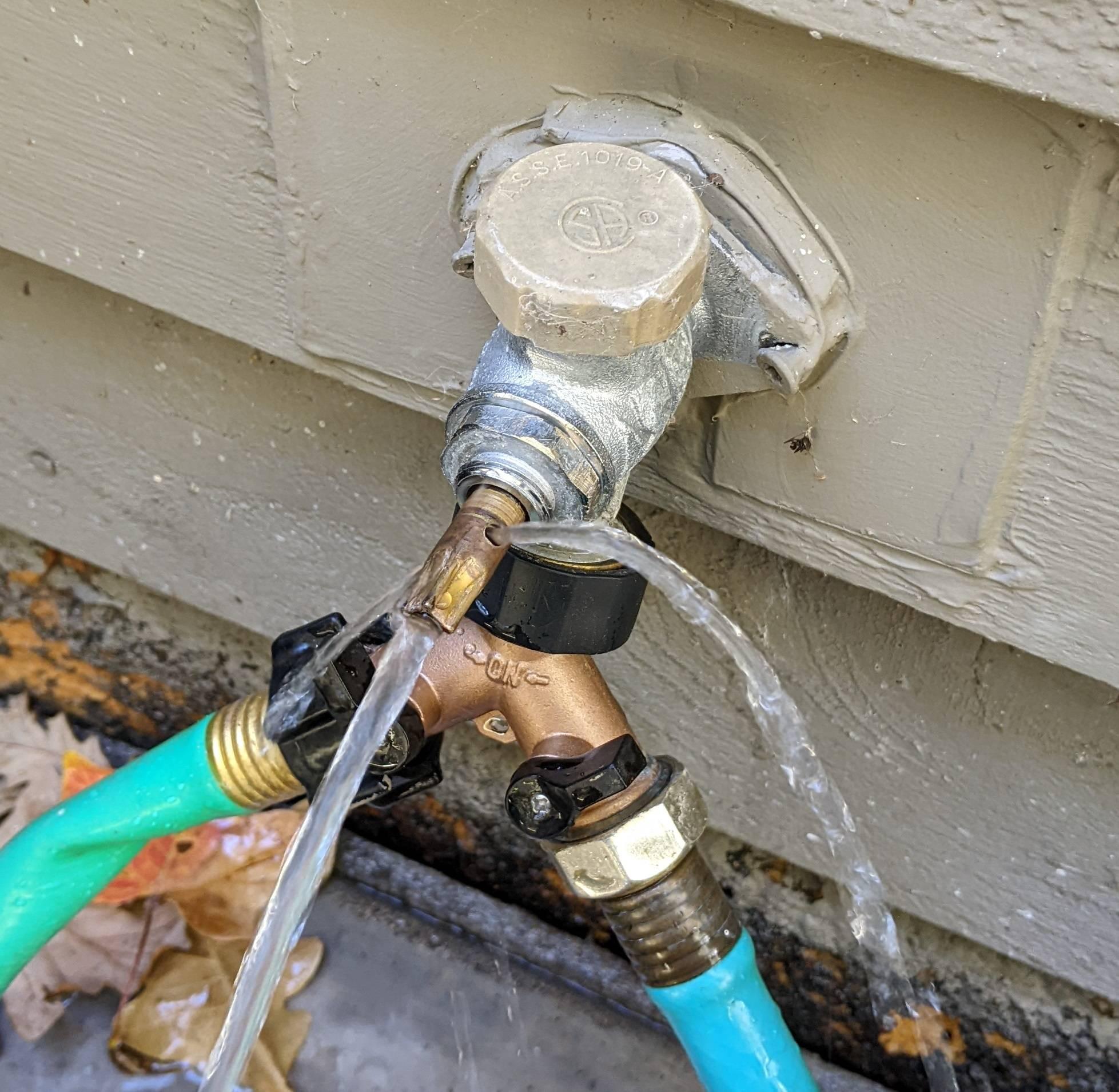
The most expensive plumbing mistake in New England takes ten seconds to make and six months to discover: you leave the garden hose connected through fall. Water gets trapped in the spigot, freezes, splits the pipe behind the wall — and you don't find out until you turn it on in spring and the wall floods. Here's how the cheapest fix in plumbing prevents it. The catch: the damage is hidden until the thaw, so prevention is everything.
People picture a frozen outdoor faucet bursting at the spout, out in the open. It doesn't. The split happens inside, in the supply pipe that runs through the rim joist or exterior wall — which is exactly why it stays invisible until water is running down your basement wall.
The timing is brutally specific. New England's first hard freezes hit from October through December, often before homeowners think to winterize. A burst from a connected hose is one of the most common — and most preventable — winter claims, and the wall and water damage can run into the thousands for a part that costs a few dollars to prevent.
Here is the reframe: a frozen hose bib doesn't fail outside — it fails behind the wall. The hose traps a slug of water in the faucet body; that water freezes, expands, and cracks the pipe inside the warm wall cavity. Come spring, you open the valve and the crack pours into the house. Stop the trap, and you stop the burst.
By the end of this you'll be able to:
→ Winterize every outdoor faucet in ten minutes
→ Tell a frost-proof spigot from a standard one
→ Spot a hidden spring burst before it floods
→ Know when to upgrade to a frost-proof sillcock
The fall winterizing steps
Start here because… this free ten-minute routine prevents nearly every hose-bib burst.
Disconnect and drain the hose. The single most important step. A connected hose traps the water that freezes and splits the pipe — pull it off every fall, every faucet.
Shut off and drain the supply. If you have an interior shutoff for the outdoor line, close it, then open the outside faucet to let the trapped water drain out. Leave the outside valve open for winter.
The faucet type that changes everything
What you're dealing with is usually… one of two very different spigots.
Standard (non-frost-proof) hose bibs. The shutoff sits right at the wall, so water lingers in the exposed pipe — these are the ones that freeze and burst. Common on older MA homes.
Frost-proof sillcocks. The shutoff sits 6–12 inches back, inside the heated wall, so the exposed section drains empty after each use. The upgrade that designs the freeze risk out — but only if no hose is left attached.
The spring burst you can't see
Reality is: a winter crack stays silent until you turn the water back on.
The first-use flood. If a pipe cracked over winter, opening the faucet in spring sends water into the wall instead of out the spout. Have someone watch the interior wall and basement the first time you use each outdoor faucet after winter — a wet spot or dripping means a burst behind the wall.
The 10-minute fall checklist
1. Disconnect every hose and drain and store it before the first hard freeze.
2. Close the interior shutoff for each outdoor line, if you have one.
3. Open the outside faucet to drain trapped water, and leave it open over winter.
4. Add an insulated faucet cover on standard spigots for extra protection.
5. Winterize irrigation — blow out sprinkler lines so they don't crack too.
6. In spring, watch the wall the first time you turn each faucet back on.
Where this goes wrong
You leave the hose on “just for now.” That's the entire failure — the connected hose is what traps the water that bursts the pipe.
You assume frost-proof means worry-free. A frost-proof sillcock can't drain with a hose attached — leave one on and it freezes like any other.
You crank a stuck spring valve. If an outdoor faucet won't flow in spring, forcing it can blow open a cracked pipe — check the wall before you wrench it.
The build order
→ First, disconnect every hose — free, instant, and it prevents the most common burst.
→ Second, shut off and drain the outdoor lines before the first freeze.
→ Third, add insulated covers on standard spigots.
→ Last, have a plumber swap standard hose bibs for frost-proof sillcocks to design out the risk for good.
The bottom line
The frozen-hose-bib burst is the rare plumbing disaster that's almost 100% preventable — and the prevention is free. Pull the hose, drain the line, and upgrade to frost-proof, and you'll never get the spring-thaw surprise.
The burst hides behind the wall and waits for spring. Pull the hose in October, and it never comes.
Tools you'll need for this job
If you want to do it yourself, here are the tools you'll need:
- Insulated outdoor faucet covers
- Frost-free hose bib / sillcock
- Foam pipe insulation
- Heat tape / heating cable
As an Amazon Associate, SouthCoast Plumbers earns from qualifying purchases.
Tools & parts for this fix
Cheap parts that beat a burst pipe:
- Insulated outdoor faucet covers
- Frost-free hose bib / sillcock
- Foam pipe insulation
- Heat tape / heating cable
As an Amazon Associate, SouthCoast Plumbers earns from qualifying purchases. Prices and availability are set by Amazon.
Want frost-proof outdoor faucets?
Browse trusted local SouthCoast plumbers who winterize and install frost-proof sillcocks — or find a hidden spring burst fast.
Find a plumber