How to Unclog a Toilet the Right Way
A clogged toilet is a five-minute fix — or a bathroom flood, depending on what you do in the first thirty seconds. The fastest tool is the one most people get wrong: the plunger. The one catch: never flush again to "test" it.
Everyone's instinct when the bowl doesn't clear is to flush again and hope. That's exactly how a clog becomes an overflow. The water has nowhere to go, so it rises — and now you have a mess on top of a clog. Hold off. The bowl will usually drain down on its own in a few minutes once you stop adding to it.
The reframe: a toilet clog isn't stuck forever — it's wedged in the trapway, and it breaks loose with a pull, not a push. Most people shove the plunger down hard, which only packs the clog tighter into the narrowing bend. The trick is to seal, then pull. You're tugging the clog back into the bowl where it can break apart.
By the end of this you'll be able to:
→ Stop the bowl from overflowing in the first place
→ Plunge with a technique that actually clears the trapway
→ Use a closet auger for the clogs a plunger can't reach
→ Follow the one rule: never flush twice to test a clog
Tools you'll need for this job
If you want to do it yourself, here are the tools you'll need:
As an Amazon Associate, SouthCoast Plumbers earns from qualifying purchases.
Phase 1 — Stop the flood
Rule of thumb: your first move is to control the water, not the clog.
Stop the fill. If the bowl is rising, take the tank lid off and push the flapper down so no more water enters, or reach down and close the shut-off valve behind the toilet. Watch-out: do this before you do anything else — it's the difference between a fix and a cleanup.
Let it settle. Wait a few minutes; the level usually drops as some water seeps past the clog. Now you have room to work.
Phase 2 — Plunge it properly
Most of the time: a flange plunger and the right motion clear the large majority of clogs.
Use the right plunger. The bell-shaped "flange" plunger (with the extra rubber sleeve) seals a toilet outlet; the flat cup kind is for sinks. Watch-out: warm the rubber under hot tap water so it flexes and seals better.
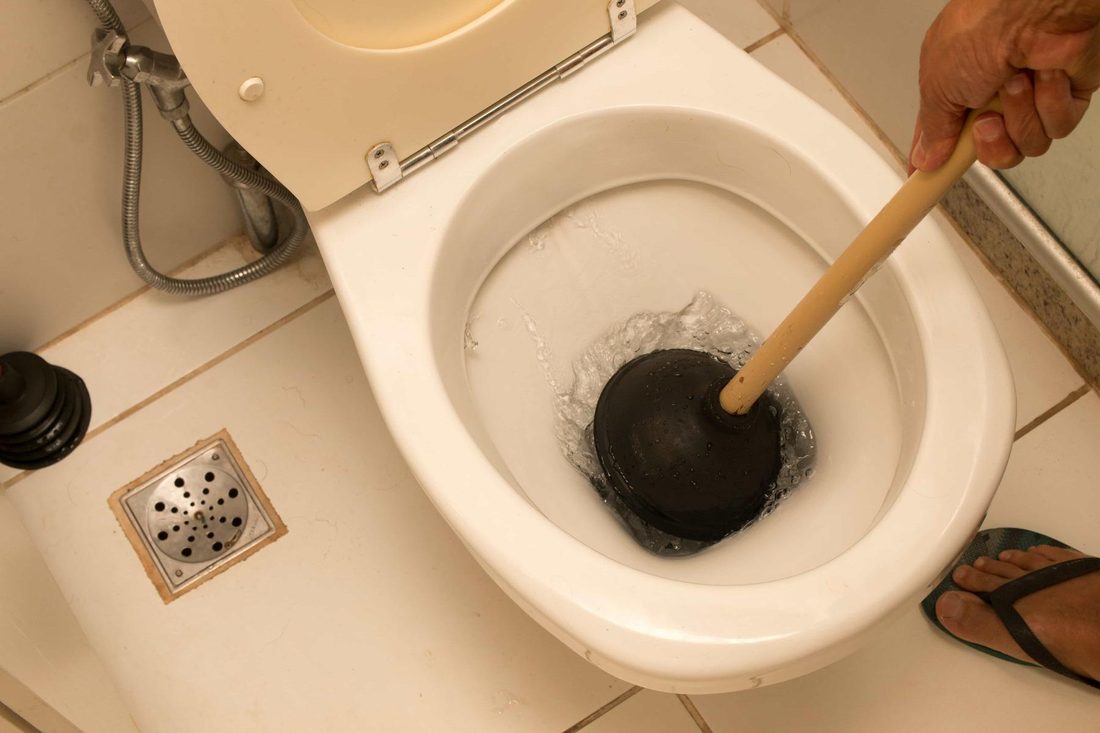
Seal, then pull. Seat it over the hole, push gently once to expel air, then pump with firm pulls — you're drawing the clog back, not driving it deeper. Keep enough water in the bowl to cover the plunger cup. After a dozen strokes, break the seal and watch the level drop.
Phase 3 — Reach it with an auger
Reality is: when plunging fails, the clog is deeper or solid — that's a closet auger's job.
Crank in a closet auger. This is the toilet-specific snake, with a rubber sleeve that protects the porcelain. Feed the cable into the trap and crank to hook or break through the obstruction, then pull it back. Watch-out: never use a regular drain snake in a toilet — it scratches the bowl. And skip the chemical drain cleaners; they don't work well on toilets and sit there caustic.
The no-overflow sequence
1. Bowl rising? Stop the fill — flapper down or valve off.
2. Wait 5 minutes for the level to drop.
3. Flange plunger, warmed, sealed — pump 12–15 strokes, pulling.
4. Still blocked? Closet auger through the trap.
5. Cleared? One normal flush to confirm — keep a hand near the valve.
Where this goes wrong
You flush again to check. The single most common cause of a bathroom flood. If you're not sure it's clear, watch the water level after plunging instead of flushing.
You use a cup plunger. It can't seal a toilet outlet, so nothing happens and you assume it's a bad clog. Use the flange type.
You reach for chemicals. They're weak on toilet clogs and turn the bowl into a tank of caustic liquid that the auger — or the plumber — then has to work through.
The build order
→ First, stop the water to prevent an overflow — free, instant.
→ Second, plunge with a sealed flange plunger, pulling not pushing.
→ Third, run a closet auger for stubborn or solid clogs.
→ Last, if multiple fixtures back up, water rises in the tub when you flush, or it clogs again and again, that's a main-line problem — call a pro.
The bottom line
Toilet clogs are easy if you control the water first and plunge correctly. Seal, pull, and resist the urge to re-flush. Almost every clog gives way before you ever need a plumber.
Stop the water first. Pull, don't push. And never, ever flush twice to test it.
Tools & parts for this fix
The two tools that clear almost every clog:
As an Amazon Associate, SouthCoast Plumbers earns from qualifying purchases. Prices and availability are set by Amazon.
Toilet clogging over and over, or backing up into the tub?
That points to the main line. Browse trusted local plumbers on the SouthCoast with customer and peer scores.
Find a plumber