Hard Water in Massachusetts: How Mineral Scale Quietly Kills Water Heaters
Massachusetts hard water never makes a scene. It just leaves a little mineral every time it's heated — a layer of scale that slowly strangles your water heater, your tankless unit, and your boiler from the inside. Here's the slow tax most homeowners never connect to the failure. The catch: the cheap fix is maintenance, and the expensive one is a new appliance.
People think of hard water as a Southwest problem. It's milder here, but plenty of MA towns still have moderate mineral content — enough that, heated day after day, it coats the parts that make hot water. The damage is invisible because it happens inside sealed tanks and coils.
The cost adds up quietly. Scale buildup can cut water-heater efficiency by up to ~25%, and sediment shortens a tank's life from its usual 8–12 years — a replacement that runs $1,200–$3,500+. On a tankless or boiler, scale on the heat exchanger is even less forgiving.
Here is the reframe: hard water doesn't clog your pipes — it insulates your heat. Scale is a stony layer that forms wherever water gets hot, and it forces the appliance to burn more energy to push heat through it. The failure isn't a blockage; it's an appliance working itself to death. Strip the scale, and the heat flows again.
By the end of this you'll be able to:
→ Recognize the everyday signs of hard water
→ Understand why heated appliances take the worst of it
→ Know the maintenance that buys back years of life
→ Decide whether a softener is worth it for your home
The signs at your fixtures
Start here because… the visible scale is just the tip of what's happening inside.
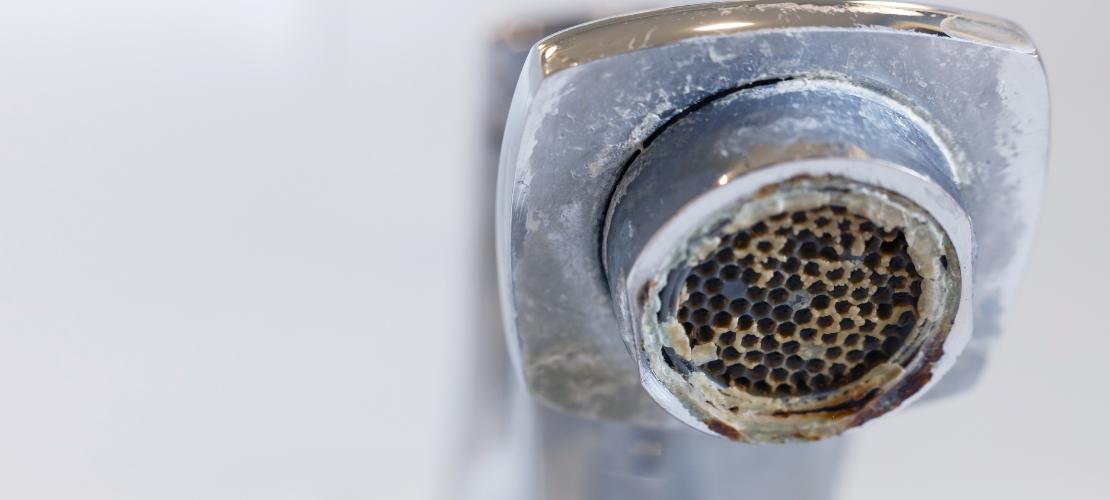
Crusty aerators and chalky buildup. White, crusty deposits on faucets, showerheads, and around drains are mineral scale — the same stuff coating the parts you can't see.
Spotty glassware and soap that won't lather. Film on dishes and fixtures and soap that fights you are classic hard-water tells, and a hint your heater is scaling too.
The signs inside the water heater
What you're dealing with is usually… a layer of sediment cooking at the bottom of the tank.
Popping or rumbling sounds. That kettle-like noise is water boiling under a sediment layer — the sound of an overworked, scaling tank.
Slow recovery and higher bills. A scaled heater takes longer to reheat and costs more to run because it's heating through a stone blanket. Efficiency drops before the tank does.
The signs in tankless and boiler systems
Reality is: the high-efficiency systems MA loves are the most scale-sensitive of all.
Tankless flow and temperature swings. Scale on a tankless heat exchanger restricts flow and triggers error codes — which is why manufacturers require an annual descale to keep the warranty alive.
Boiler and hydronic efficiency loss. Scale on a boiler's heat exchanger and in the loop drops efficiency and stresses components — a real concern in Massachusetts, where boiler heat is everywhere.
Beat the scale — the maintenance plan
1. Flush the water heater yearly: draining the sediment is the single biggest life-extender, and it's cheap.
2. Descale tankless units annually: a vinegar or descaler flush keeps the heat exchanger clear (and the warranty valid).
3. Clean aerators and showerheads: soak in vinegar to restore flow — a five-minute job.
4. Service the boiler on schedule: have a pro check for scale in the loop and on the exchanger each heating season.
5. Consider a water softener or conditioner: for harder-water homes, it protects every appliance and fixture at once.
Where this goes wrong
You never flush the heater. Years of sediment can cut its life nearly in half — and you replace a tank you could have maintained.
You skip the tankless descale. It voids many warranties and lets scale quietly choke the most expensive part of the unit.
You treat low flow as “just the plumbing.” Scaled aerators and valves are an easy fix — ignored, they hide a heater that's scaling too.
The build order
→ First, flush the water heater and clean the aerators — cheap, fast, and immediately effective.
→ Second, put the tankless or boiler on an annual descale/service schedule.
→ Third, test your water's hardness so you know what you're dealing with.
→ Last, add a softener if the numbers are high and you want to protect everything at once.
The bottom line
Hard water won't flood your basement — it just quietly taxes every appliance that heats water until one dies early. A yearly flush and an annual descale buy back years of life for a fraction of a replacement.
Hard water doesn't clog the pipe — it insulates the heat. Strip the scale, and your appliances breathe again.
Tools you'll need for this job
If you want to do it yourself, here are the tools you'll need:
- Whole-house water softener
- CLR / descaler
- Showerhead with mineral filter
- Whole-house sediment filter
As an Amazon Associate, SouthCoast Plumbers earns from qualifying purchases.
Tools & parts for this fix
Fight South Coast hard water with:
- Whole-house water softener
- CLR / descaler
- Showerhead with mineral filter
- Whole-house sediment filter
As an Amazon Associate, SouthCoast Plumbers earns from qualifying purchases. Prices and availability are set by Amazon.
Noisy heater or scaly fixtures?
Browse trusted local SouthCoast plumbers who flush heaters, descale tankless and boiler systems, and install softeners that protect the whole house.
Find a plumber