Garbage Disposal Won't Turn On? Try These Fixes Before You Replace It
A disposal that won't turn on feels like a $200 problem. Four times out of five it's a free one. Before you shop for a new unit, run the same checks a plumber runs — most take under five minutes, and your hand never goes in the drain.
The instinct when a disposal goes quiet is to assume the motor finally burned out. It rarely has. Disposals are built with two safety cutoffs because they jam and overload so often, and both reset for free. The trick is matching what you hear — or don't hear — to the right fix instead of guessing.
The reframe: a disposal that won't turn on usually stopped itself on purpose. A jam tripped the overload, or a flipped switch cut the power. Replacing the unit when the only thing wrong is a tripped reset is the most common money wasted in the kitchen.
By the end of this you'll be able to:
→ Read the symptom — hum, click, or dead silence
→ Free a jam and restore power without any tools you don't already own
→ Rule out the breaker, GFCI, and wall switch
→ Know the four signs the unit is genuinely done
Tools you'll need for this job
If you want to do it yourself, here are the tools you'll need:
As an Amazon Associate, SouthCoast Plumbers earns from qualifying purchases.
Before anything: cut the power
This is the one rule that makes everything below safe. Flip the wall switch off and unplug the disposal under the sink (or shut its breaker). A disposal that hums has live power and a motor trying to spin — treat the chamber as dangerous until the power is off. Use a flashlight to look inside and tongs to pull anything out. Never your fingers, even with the switch off.
If it hums but won't spin — it's jammed
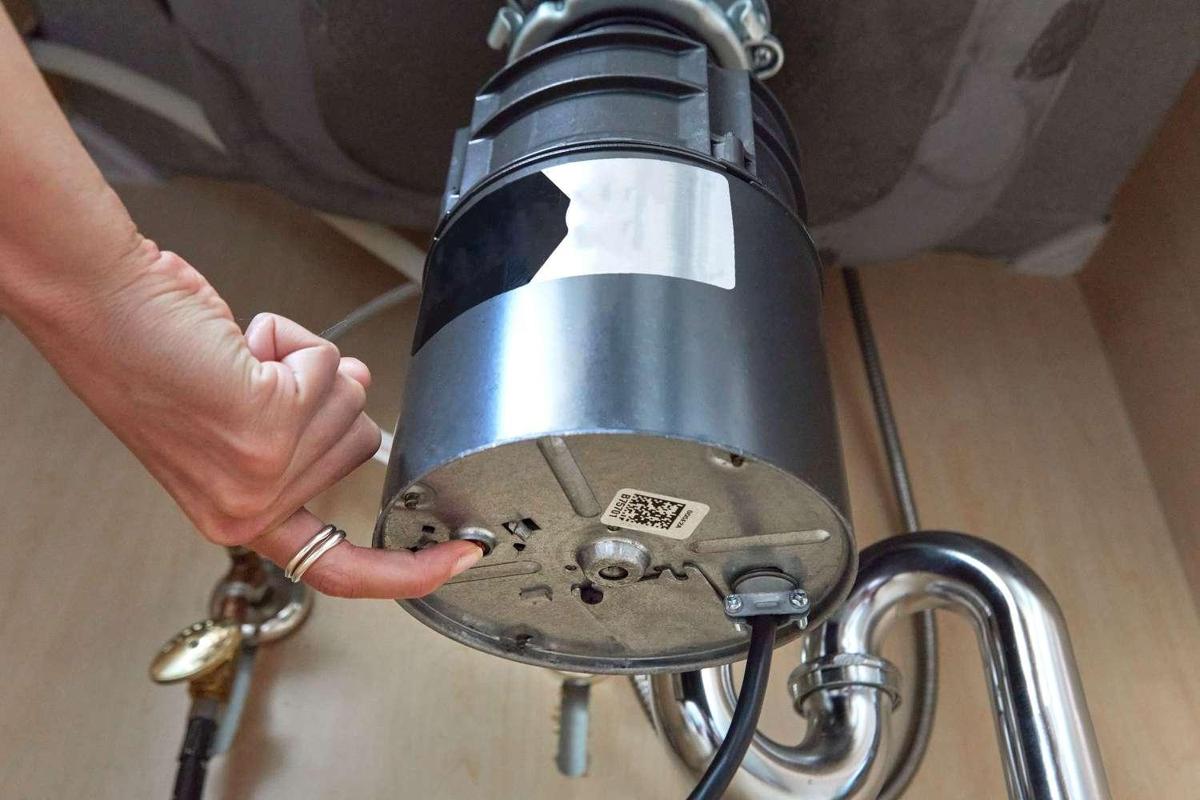
A hum means power is reaching the motor but something is blocking the grinding plate. On the South Coast that something is often a shard of shell, a fruit pit, or a buildup of fibrous scraps. With the power off, find the hex (Allen) wrench that shipped with the unit — usually clipped to the disposal body or in a kitchen drawer — and fit it into the socket on the very bottom center of the unit. Crank it back and forth a few times to break the plate free. If you feel it loosen and spin freely, the jam's cleared.
If it's dead silent — power isn't reaching it
No sound at all points to power, not the motor. Work these in order:
1. The reset button. On the bottom of the disposal is a small button, usually red. If it's popped out, the overload tripped — push it firmly back in. This alone revives a huge share of "dead" disposals.
2. The wall switch and GFCI outlet. Make sure the switch that runs the disposal is actually the right one (in older South Coast kitchens it's easy to flip the wrong one), and check whether the outlet under the sink has a tripped GFCI — press its reset.
3. The breaker. Find the kitchen circuit in your panel. If it's tripped, reset it. Watch-out: if it trips again the moment you reset it, stop. That's an electrical fault, not a reset — call a plumber or electrician.
Clear and restart
With the jam freed and power restored, turn on a strong stream of cold water, then flip the disposal on for a few seconds. Cold water, never hot — hot water melts grease so it re-hardens further down the line and clogs your trap. If it spins and grinds normally, you're done.
The 5-minute checklist
1. Power off and unplug — non-negotiable.
2. Humming? Work the bottom hex wrench back and forth to free the jam.
3. Silent? Press the red reset button, then check the GFCI, wall switch, and breaker.
4. Restore power, run cold water, switch on for 5 seconds.
5. Still nothing — or it leaks or smells burnt? Skip to the replacement signs below.
The four signs it's actually time to replace it
It leaks from the bottom. A leak from the body (not the connections) means the internal seals have failed. That's the end of the unit's life, not a repair.
You smell burnt motor. A sharp electrical or burning smell when you hit the switch means the motor windings are cooked. Stop using it.
The reset won't hold. If the red button pops right back out every time, the motor is overheating on its own — it's failing.
It's simply old. Disposals last about 8–12 years. If yours is past that and acting up, repairs are throwing good money after bad. Replacement units are inexpensive; the install is where a plumber earns their fee.
The bottom line
A disposal that won't turn on is jammed, tripped, or unplugged far more often than it's broken. Read the symptom, work the hex wrench or the reset button, and rule out the breaker before you spend a dime. If it leaks, smells burnt, or won't hold a reset, that's your green light to replace — and the one job worth handing to a pro.
Most "dead" disposals aren't dead. They're waiting on a button you haven't pushed yet.
Keep reading: Garbage Disposal Reset Button Not Working? · How to Fix a Garbage Disposal That Won't Work · How to Clear a Clogged Drain
Tools & parts for this fix
If the reset won't hold:
As an Amazon Associate, SouthCoast Plumbers earns from qualifying purchases. Prices and availability are set by Amazon.
Leaking, burnt out, or dead after every reset?
That's a replacement or wiring job. Browse trusted local plumbers on the South Coast with customer and peer scores.
Find a plumber