
Cast Iron Drain Pipes: Why Old Massachusetts Homes Get Slow Drains and Sewer Smell
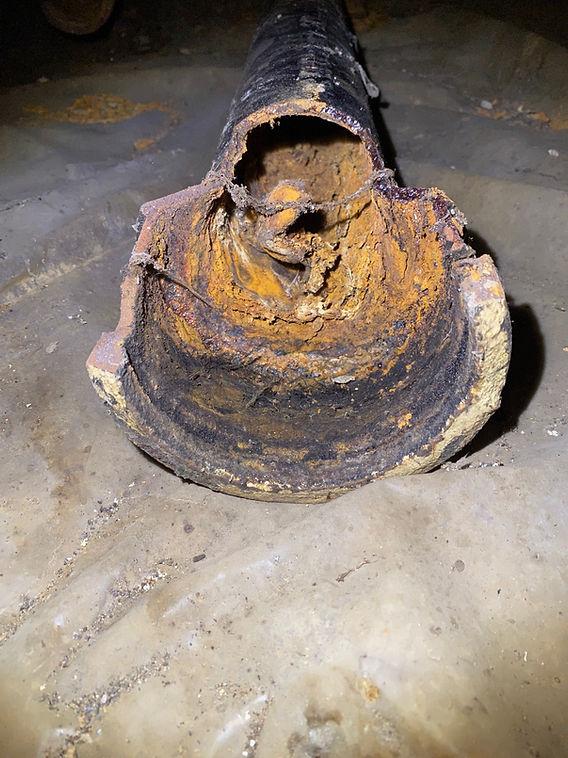
Massachusetts has some of the oldest housing in the country — and a lot of it still drains through cast iron installed before 1960. Cast iron lasts a long time, but it doesn't last forever: it rusts from the inside out for years before it ever leaks. Here's how to read the warning signs. The catch: by the time you smell sewer gas, the pipe has usually been dying for a decade.
Most homeowners think a drain problem is a clog — something stuck that a snake will clear. In an old house, that's often not it. The pipe itself is corroding, narrowing, and flaking apart, and no amount of drain cleaner fixes rotted metal.
The scale is real. Cast iron waste pipe has a service life of roughly 50–75 years, and a huge share of Boston-area, New Bedford, and Fall River homes are well past that. A failing cast iron stack or buried lateral runs $3,000–$10,000+ to replace — far more once it's leaking inside a wall or slab.
Here is the reframe: cast iron doesn't break — it dissolves. The failure isn't a sudden crack; it's a slow internal rot called channeling, where the bottom of the pipe rusts away while the top still looks fine. That's why the symptoms creep in instead of announcing themselves. Read the creep, and you get ahead of the repair.
By the end of this you'll be able to:
→ Tell a failing cast iron pipe apart from an ordinary clog
→ Recognize the three stages of cast iron decay
→ Know what a plumber actually does to diagnose and fix it
→ Decide between spot repair, relining, and full replacement
The signs from inside the house
Start here because… the first symptoms show up at your fixtures, long before anything leaks.
Slow drains that come back fast. You snake the tub or kitchen line, it works for a week, then slows again. Recurring slowdowns in an old home point to a narrowing pipe, not a one-off clog.
Sewer odor inside the home. A persistent rotten-egg smell near a drain or in the basement means gas is escaping through a corroded section or a cracked joint — the pipe's seal is failing.
The signs from inside the pipe
What you're dealing with is usually… rust eating the pipe wall from the water side out.
Rust-colored flakes and grit in the drain. Brown or black scale washing up when a drain backs up is literally pieces of the pipe. That's channeling in progress.
Recurring backups in the lowest fixtures. Basement floor drains, first-floor toilets, and laundry standpipes back up first because they sit at the bottom of the stack — the spot where corrosion and sludge collect.
The signs from outside the wall
Reality is: once the rot reaches the joints, water and gas escape the pipe entirely.
Damp spots, staining, or mold along drain runs. Wet drywall or a musty patch near a vertical stack often means the pipe is weeping inside the wall. In a finished basement, that's how a slow drain becomes a five-figure repair.
How a plumber diagnoses and fixes it
Diagnose: a sewer camera inspection is the only way to know — it shows channeling, cracks, sags, and root intrusion and tells you how much pipe is bad.
Clear & assess: hydro-jetting removes scale and sludge so the camera can read the real pipe condition.
Repair options: spot-replace a single bad section; trenchless reline a buried lateral with an epoxy sleeve where the host pipe still holds; or fully replace stacks and lines with PVC.
The upgrade: most MA plumbers replace failing cast iron with PVC, which won't corrode — ending the cycle for good.
Where this goes wrong
You keep snaking it. Snaking clears a clog but can punch through a rotted pipe wall — turning a slow drain into an active leak.
You pour chemical drain cleaner in. It accelerates corrosion on already-thin cast iron and rarely touches the real problem.
You wait for the leak. A planned replacement is drywall-and-a-day. An emergency one is a flooded finished basement plus the pipe bill.
The build order
→ First, get a sewer camera inspection if your home predates 1965 and drains are slow — it's the cheapest clarity you can buy.
→ Second, hydro-jet to clear scale and confirm the pipe's true condition.
→ Third, spot-repair or reline the worst sections if the rest still has life.
→ Last, plan a full PVC replacement of stacks and laterals before failure forces it.
The bottom line
Cast iron is a slow-motion failure, not a surprise. The flakes, the smell, and the drains that won't stay clear are the pipe telling you its time is up — and a camera inspection turns that warning into a plan instead of a flood.
Cast iron doesn't crack — it dissolves. Catch the rot on camera, not on your basement floor.
Old drains acting up?
Browse trusted local SouthCoast plumbers who camera-inspect and replace aging cast iron — before a slow drain becomes a wall repair.
Find a plumber