Basement Sewer Backups: Why Old MA Cities Flood When It Storms
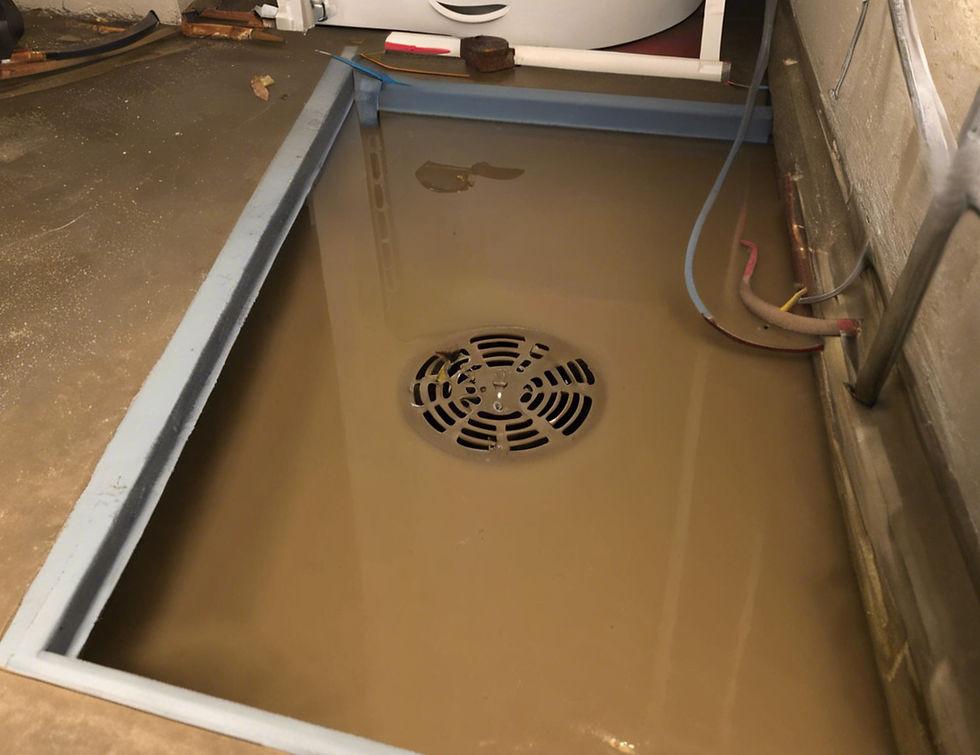
There's a specific kind of basement flood that has nothing to do with your plumbing being broken: the storm-day sewer backup. Heavy rain overwhelms an aging municipal system, the overflow has to go somewhere, and in older Massachusetts cities it pushes back up through the lowest drain in your house. Here's why it happens to good pipes. The catch: a one-way valve can stop it for a few hundred dollars.
Most homeowners assume a backup means their line is clogged. During a downpour in an old city, the clog is often the whole municipal system. When the public sewer surcharges, it pressurizes everyone's lateral — and the water reverses into the easiest opening it can find.
The infrastructure makes it regional. Older cities like Cambridge, Somerville, Lowell, and Fall River have stretches of combined sewers that carry sewage and stormwater in the same pipe. In a big storm they surcharge, and a sewage backup is one of the most expensive and unhealthy floods a home can take — cleanup commonly runs thousands, and standard policies often exclude it without a backup rider.
Here is the reframe: a storm-day backup isn't your pipe failing — it's the city's pipe overflowing into yours. The water isn't coming from your house; it's coming from the street, up the lateral, and out your basement drain. That changes the fix entirely: you're not unclogging a line, you're installing a one-way door.
By the end of this you'll be able to:
→ Tell a storm-day backup from an ordinary clog
→ Understand why old combined sewers surcharge
→ Know what a backwater valve does and where it goes
→ Build a layered defense for a finished basement
The municipal cause
Start here because… the trigger is usually outside your property line.
Combined-sewer surcharging. When rain and sewage share one undersized pipe, a heavy storm fills it past capacity and the system backs up toward every connected home — yours included.
The tell: it happens during or right after heavy rain. A backup that strikes only in storms, often in multiple lowest fixtures at once, points to the main, not your drain.
The home-side cause
What you're dealing with is usually… an aging lateral that gives the surcharge an easy path in.
Old, cracked, or root-filled laterals. A deteriorating sewer lateral both restricts normal flow and offers less resistance to a surcharge — the home-side half of the problem.
The lowest fixtures go first. Basement floor drains, laundry standpipes, and first-floor toilets back up first because they sit at the bottom of the system — the exit the reversing water finds easiest.
The defense
Reality is: you can't fix the city's pipe, so you control your connection to it.
Backwater (backflow) valve. A one-way valve installed in the main line lets waste flow out but slams shut when water tries to come back in — the single most effective defense against a storm-day backup.
Build a storm-proof basement
1. Install a backwater valve on the main sewer line — the core protection against municipal surcharge.
2. Camera-inspect the lateral so you know its real condition and clear roots or breaks that worsen backups.
3. Snake or jet on a schedule if your line is older or root-prone — keep it flowing at full capacity.
4. Keep valuables off the floor and store on shelves or pallets in backup-prone basements.
5. Add a sewage-backup rider to your insurance — the standard policy usually won't cover it.
Where this goes wrong
You keep snaking your own line. If the backup is municipal surcharge, your clean pipe isn't the problem — and the next storm brings it right back.
You skip the backwater valve. It's the one device built for exactly this failure; without it, you're relying on the city's pipe never overflowing.
You assume insurance has you covered. Sewage backup is a common exclusion — find out before the storm, not after.
The build order
→ First, confirm the pattern — storm-only backups in the lowest fixtures point to surcharge.
→ Second, install a backwater valve — the highest-leverage fix.
→ Third, camera and clear the lateral so your side flows freely.
→ Last, add the insurance rider and keep the basement floor clear.
The bottom line
A storm-day sewer backup isn't a sign your plumbing failed — it's the city's overloaded sewer looking for the nearest exit. Put a one-way valve between you and the street, and the next nor'easter stays out of your basement.
You can't fix the city's sewer — but you can shut the door it pushes through.
Basement backs up when it storms?
Browse trusted local SouthCoast plumbers who install backwater valves and inspect laterals — before the next big rain.
Find a plumber